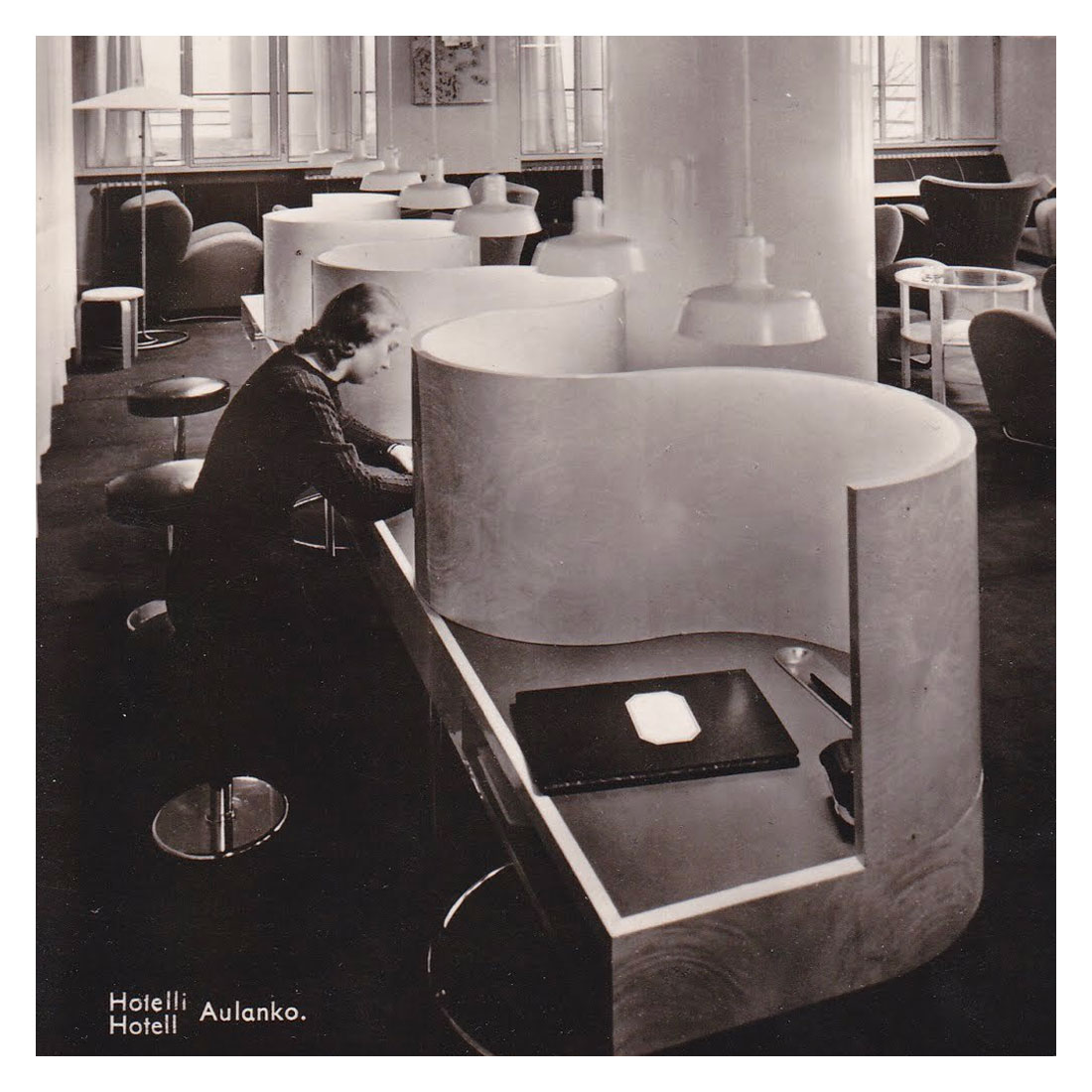
Maija Heikinheimo (14 December 1908 – 8 January 1963) was one of the most significant Finnish interior designers of the twentieth century — and one of its most systematically overlooked. For over two decades she served as the creative backbone of Artek, the design company co-founded by Alvar Aalto, functioning as both artistic director and, for a period, managing director. Yet she left the majority of her designs unsigned or attributed them to others, a practice that ensured her near-total disappearance from design history until recent scholarship began to restore her rightful place.
Family and early life
Heikinheimo was born in Helsinki as the eldest of five children in an intellectually prominent family. Her father, Mikko Heikinheimo (1881–1960), was Professor of Electrical Engineering at Helsinki University of Technology from 1916 to 1945; her mother was Anna Heikinheimo (née Rehnbäck-Reinilä, 1879–1960). The family settled at Temppelikatu 1 in Etu-Töölö in 1916, the neighbourhood that would remain the backdrop to much of her adult life.
She showed artistic talent from childhood, winning a drawing competition in the children’s publication Lasten lähetyslehti as early as 1923. Her upbringing was religious and the household placed emphasis on modesty, helpfulness, and quiet competence — traits that would later define her professional conduct and, ultimately, contribute to her historical invisibility. She took a year away from school due to exhaustion before graduating in 1929, an early indication of the chronic fatigue that would mark her throughout her career.
Her younger brother Matti (1911–1941) was killed in the Continuation War. Heikinheimo never married, devoting her life entirely to her work.
Education
From 1929 to 1932, Heikinheimo studied at the Taideteollisuuskeskuskoulu (Central School of Arts and Crafts) in Helsinki, in the furniture and decorative drawing department (the B-department). Her cohort was exceptional: classmates included Kaj Franck, with whom she would maintain a close friendship and working relationship throughout her career, as well as Gunnel Gustafsson (later Nyman), Styrbjörn Andersin, Paavo Rekola, Erkki Siitonen, and Åke Wasastjerna.
Her primary teacher was Arttu Brummer, whose influence on the entire generation of Finnish designers trained in the early 1930s was decisive. Werner West was also among her teachers. She won multiple prizes in school competitions in her first year and received stipends from the Taideteollisuusyhdistys.
A formative experience came in 1930, when she visited the Stockholm Exhibition (Stockholmsutställningen) — the landmark Scandinavian modernist fair that crystallised a functionalist aesthetic across the Nordic countries. The exhibition left a clear imprint on what would become her characteristic style: simplified forms, restrained decoration, and an emphasis on everyday usability.
Her formal education continued in supplementary ways throughout the 1930s. She audited art history and aesthetics lectures at the University of Helsinki in 1936–1937, and made two important stipend trips: to Sweden in 1934, where she met the influential furniture designer Carl Malmsten, and to Europe — Germany, Italy, France, and the Paris World’s Fair — between April and July 1937, funded by the Alfred Kordelin Foundation. It was at the Paris World’s Fair that she first met the Aaltos, a meeting that led directly to her joining Artek.
Asko (1932–1936): Restrained everyday functionalism
After graduating, Heikinheimo was appointed the first permanent in-house designer at Asko-Avoniuksen Huonekalutehtaat in Lahti, a furniture manufacturer founded in 1918. She was hired to modernise and simplify the company’s production line, and her scope was broad: furniture design, all trade fair and exhibition stands, signage, and typography, extending even to the gatehouse building.
Her most commercially successful designs from this period include armchair no. 203, which sold 300–400 units per year between 1934 and 1937, and the Apu side table no. 604, popular from 1934 to 1945 and still sought at auction today. She also designed the Maija armchair no. 242 and the Helvi armchair no. 227.
Major projects included the Lahti trade fair in 1934 and the Helsinki general fair in 1935, for which she developed the concept ‘Yhden hengen koti’ — a one-person home — a conceptually forward-thinking proposition for the period. Design historians have characterised her Asko output as ‘restrained everyday functionalism,’ noting that her aesthetic was ahead of the market. She remained at Asko until 1936, with some drawings dated as late as January 1937, somewhat later than has traditionally been stated.
Artek, first period (1937–1941): Working alongside Aino Marsio-Aalto
Heikinheimo joined Artek in August 1937, shortly after her European study trip. Artek had been founded in 1935 by Alvar Aalto, Aino Aalto, Nils-Gustav Hahl, and Maire Gullichsen, and was still in its formative years when she arrived. She was employed at a salary that was, from the outset, nearly equivalent to that of Aino Marsio-Aalto — in practice, slightly higher: 2,500 marks per month compared to Marsio-Aalto’s 2,000 marks. The salary parity was a signal of how seriously her contribution was valued.
Her work at Artek during this first period was primarily in close collaboration with Aino Marsio-Aalto, functioning as her creative colleague and practical executor across major commissions. These included Restaurant Savoy (1937), Villa Mairea (1938–1939), the Consul Allan Hjelt apartment on Unioninkatu in Helsinki (designed 1939, executed 1944), the Malmi Airport restaurant and bar (1938/1947), children’s homes in Karhula and Noormarkku (around 1939–1941), and the Paul Eklöf apartment in Kaivopuisto (1938–1940, previously unpublished). For Villa Mairea, she designed some original furniture, including a wicker chair that later entered the Artek catalogue as no. 370.
She also curated the Paolo Venini glass exhibition at Artek in April 1939, demonstrating the breadth of her role beyond interior execution.
Wartime: Oy Wilh. Schauman, Jyväskylä (1941–1945)
During the Continuation War, Heikinheimo moved to Jyväskylä to work at the Schauman plywood factory (Oy Wilh. Schauman). Her role there was broader than has previously been documented: in addition to furniture and interior design, she was involved in improving employee housing, organising training and educational programmes for factory workers, and delivering public lectures on interior design and matters of taste. Designs for workers’ apartments were published in the company magazine Schaumanin Sauma in 1944.
A list of 52 furniture and design items for Schauman, held in the Alvar Aalto Museum archive, spans from January 1940 to June 1945, indicating that her involvement predated and outlasted the formal wartime period. She maintained her connection to Artek throughout this time; several Schauman interiors incorporated Aalto furniture.
The loss of her brother Matti at the front in November 1941 marked this period personally. At the end of the war, she returned to Helsinki and to Artek — drawn back, according to thesis sources, specifically by Aino Marsio-Aalto.
Independent commissions
Alongside her institutional roles, Heikinheimo undertook a significant body of independent interior design work, much of which has only recently been identified.
Her largest independent commission was the furniture and interior design for the Helsingin yliopiston Metsätieteellinen tutkimuslaitos (Forest Research Institute), part of the Metsätalo building designed by architect Jussi Paatela (1939–1940). The budget was 1.7 million marks (equivalent to approximately €570,000 today). Heikinheimo designed all furniture for the institute wing independently — working separately from Arttu Brummer and Runar Engblom, who handled the university side — and notably used multiple domestic wood species including rowan, reportedly for the first time in Finnish furniture design. She supervised production directly.
Other documented independent projects include: a meeting room (‘Jääkärihuone’) for the Ostrobotnia building in 1939; the interior of the Imatran kirjasto (Imatra Library) extension in 1954; colour schemes and interiors for A. Ahlström’s Varkaus factory in the early 1950s; the interior of a Helsinki Säästöpankki (savings bank) branch, possibly her last completed work; and the Finnish Embassy in Vienna, where she combined older furniture with Artek pieces.
She also designed the interior of Sarvisalon kappeli, a small chapel completed in 1962, pro bono, as a summer resident of the island. It is the only known sacred building she worked on, and is notable for its use of Artek A110 lamps. Heikinheimo is buried in the chapel cemetery alongside her parents.
Throughout her career she also designed interiors and individual pieces of furniture for family members and friends.
Artek, second period (1945–1963): Artistic and managing director
When Aino Marsio-Aalto died in January 1949, Heikinheimo was appointed acting managing director of Artek on 18 February of that year. She held dual responsibility — managing director (until 1955) and artistic director (until her death in 1963) — across what design historian Pekka Suhonen has called ‘Heikinheimon aika’: Artek’s post-war years through the early 1960s.
The major architectural interiors she led during this period include MIT Baker House (1949), the Insinööritalo/Engineers’ House (1951), the Säynätsalon kunnantalo/Säynätsalo Town Hall (1949–1952) — for which she designed the council chamber furniture including the chairman’s chair, delegate chairs, tables, and benches. Aalto publicly credited himself and “the artist Maija Heikinheimo” (with Artek’s drawing office “under her leadership”) for the special furnishings. The Kansaneläkelaitos (Kela) headquarters (1953–1956), including library shelving and reading alcove tables, and the Café de Colombia in Rautatalo (1951–1957), which made extensive use of marble, ceramics, leather, bronze, and brass. She also led interior work for the Enso-Gutzeit headquarters (1959–1962) and Interskandinavinska Artek in Stockholm.
For the Harvard Woodberry Poetry Room (1947–1949) she worked on the interior alongside the Aalto office in one of Artek’s most prominent international commissions.
Exhibition work during this period was equally significant: the Artek 20th anniversary exhibition, the Finnish Design Ltd exhibition/retail space in Haymarket, London in 1958, the H55 Helsingborg fair, and the Interbau Berlin exhibition in 1957 — for which she designed the model apartment in the Hansaviertel — established Artek’s international visibility during a critical postwar decade. She travelled extensively in connection with these commissions, visiting Denmark, Italy in 1956 (where she met Venini, Marino Marini, and the Sambonet studio), Spain and Africa in 1952.
In 1955, Heikinheimo voluntarily resigned the managing directorship, finding the financial management responsibilities ill-suited to her temperament. Maire Gullichsen took over as managing director; Heikinheimo retained the role of artistic director and was given her own office in Artek’s new Rautatalo premises. A letter from Gullichsen in 1954, quoted in Koski’s thesis, describes Heikinheimo as ‘going from insight to insight, never been so sure and accomplished.’
Maison Louis Carré (1956)
When Alvar and Elissa Aalto began designing the Maison Louis Carré — a private residence for the French art dealer Louis Carré in Bazoches-sur-Guyonne, outside Paris — Heikinheimo was central to the furniture work. Heikinheimo undertook new furniture designs for the project and, together with Elissa Aalto, made modifications to existing Aalto furniture that were described as “standard yet unique.” The highly wrought interiors of the Carré house were considerably more luxurious than either the Aalto atelier or Artek was accustomed to, requiring a level of design detail that pushed both beyond their usual register.
The commission coincided with Heikinheimo’s Italy trip that same year, during which she met Paolo Venini, Marino Marini, and Roberto Sambonet — a period that represented the high-water mark of her international engagement. Within a few years her health would begin to decline. The Maison Louis Carré stands as one of her last major contributions to an international project, and one of the few where her name is attached to work outside Finland.
Object design
In addition to interiors, Heikinheimo designed a series of small metal objects for Artek during the 1950s, including a coffee set, candleholders, trays, hand mirrors, and a table mirror. A tea pan with teak handle was also produced. The Artek no. 43 armchair has been attributed to her.
A colour in the Artek paint range was named ‘Maija Heikinheimon sininen’ (Maija Heikinheimo’s blue). A white wallpaper in Li Uotila-Englund’s 1957–1958 collection was named ‘Maijan valkoinen’ — ‘Maija’s white.’ It must also be noted that Maija Heikinheimo’s watercolour sketches are unique works and show her artistic side.
For Norrmark Handicraft — a workshop founded in 1961 by Maire Gullichsen and jeweller Bertel Gardberg — she designed a safari chair and matching stools in the final years of her career. The same chair can be seen as a part of the furnishings at the Kolttaköngäs hotel in Petsamo by Maija Heikinheimo and Aino Marsio-Aalto.
Attribution and the question of authorship
One of the most consequential aspects of Heikinheimo’s career is the systematic absence of her name from the work she produced. At Artek, the prevailing convention was to attribute designs to Alvar Aalto; Heikinheimo signed only what she considered ‘less important’ pieces with the abbreviation ‘MHho.’ Analysis of approximately 5,000 working drawings in the Artek archive reveals that she appears as drafter in 977 drawings but as designer (in Finnish, sommittelija) in only 30.
Her reluctance to claim authorship was not only institutional convention. Koski’s research suggests that Heikinheimo harboured a genuine inferiority complex relative to the trained architects around her — particularly Aino Marsio-Aalto — and preferred the title ‘sisustustaiteilija’ (interior artist) over ‘sisustusarkkitehti’ (interior architect), a distinction that in her own assessment placed her below the architects with whom she worked. This disposition, combined with the attribution practices of the Aalto office, ensured that her contribution was effectively invisible for decades.
Professional activities and recognition
Heikinheimo was a member of Ornamo, the Finnish design association, from 1938. She was a co-founder of Sisustusarkkitehdit SIO ry (Interior Architects SIO) and served as its first chairperson in 1955–1956. She was also a member of the administrative council of the Taideteollisuuskeskuskoulu from 1950 to 1952.
Her awards included a Silver Medal (Médaille d’argent) at the Paris World’s Fair in 1937, a prize at the Milan Triennale in 1933 (for textiles), and the Pro Finlandia medal in 1959.
Her exhibition work with Kaj Franck included ‘Kauneutta arkeen’ in 1949 — described by contemporaries as groundbreaking, the first exhibition in Finland to use partitions to frame individual objects — and a retrospective design exhibition in 1959.
Design philosophy
Heikinheimo’s interiors were characteristically neutral in colour, with colour introduced exclusively through textiles. She favoured the integration of plants and greenery as a core design element rather than an afterthought. Her handling of wood was considered exceptional: she used multiple species with skill, often combining dark-finished structural elements with lighter surfaces, and made use of steam-bent components with a fluency that characterised her school-period training.
Her sister summarised her aesthetic advice in three words: ‘hyvin, hyvin yksinkertaista’ — very, very simple. The design critic Severi Parko, writing in a posthumous tribute in 1963, described her as embodying ‘a philosophy of cosiness’ achieved through ‘incomparable sensitivity.’
Koski’s thesis frames her consistent approach as ‘sophisticated simplicity’: a thread running from her Asko furniture of the early 1930s through to the chapel interior she completed in the final year of her life.
Maija Heikinheimo’s oeuvre is truly worthy of honour, and worthy of honour is also the person behind the work. In a profession and a world increasingly characterised by self-assured talk and outward glamour, she moved in humble anonymity — an honest person, a sensitive artist, and at the same time an administrative force of natural authority.”
– Benedict Zilliacus’ obituary on Maija Heikinheimo in Hufvudstadsbladet 1963
Final years and death
In 1959, Heikinheimo moved to the Degerö (Laajasalo) district of Helsinki, where she and her colleague Sinikka Killinen had jointly purchased a plot of land; Killinen lived in the larger house, while Heikinheimo renovated the smaller one, the houses burned in May 2021. Heikinheimo suffered a serious health episode in the spring of 1962 and she died on Tuesday 8 January 1963 at the age of 54.
Following her death, Aalto’s office hired its first interior architect, Pirkko Söderman, and the close working relationship between the Artek commercial operation and the Aalto design office — which Heikinheimo had sustained and embodied for over two decades — came to an end.
“Maija Heikinheimo, a person who understood art, drew a great deal of furniture for Aalto’s buildings at Artek, but she was so modest that she always said they were created in collaboration with the architects, and never put her own name forward. I remember her as the central designing soul of Artek.”
– Maire Gullichsen, Helsingin Sanomat on 24 June 1982
Maija Heikinheimo (1908 – 1963)
- Received the Pro Finlandia medal in 1959
- Exhibitions and furnishings
- The apartment exhibition in Noormarkku (1946)
- The Säynätsalo Town Hall (1950)
- H55 in Helsingborg (1955)
- The Social Insurance Institution building (Kela) (1956)
- International Architectural Exhibition Interbau (1957)
- Finnish Design Ltd in Haymarket, London (1958)
- Museum of Central Finland (1960)
- Several exhibits for the Union for Industrial Design in Finland
- Best known for her work at Asko and Artek and close work with the Aaltos.
Sources:
This article has been expanded using Iina Koski’s ‘Sisustusarkkitehti Maija Heikinheimon elämäntyön kartoitus sekä uran vaiheet Artek Oy Ab:ssä vuosina 1937–1941 ja 1945–1963,’ Master’s thesis, University of Jyväskylä, Spring 2025. The thesis is the first comprehensive biographical study of Heikinheimo and draws on archival material from the Alvar Aalto Museum, the Asko archive, and family sources.
Interview with the Heikinheimo family 29.8.2021
AINO MARSIO-AALTO JA MAIJA HEIKINHEIMO LAPSILLE SUUNNATTUJEN TILOJEN SUUNNITTELIJOINA: KARHULAN JA NOORMARKUN LASTENTALOJEN SISUSTUSSUUNNITELMAT
Damastin traditio ja innovaatio
CENTRALSKOLAN FÖR KONSTFLIT 1946-1947
Taste – A cultural history of home interior from 1800 to today
Artek and the Aaltos: Creating a Modern World by Nina Stritzler-Levine (2017)
Photo credits:
Rattan chairs from Nordisten