
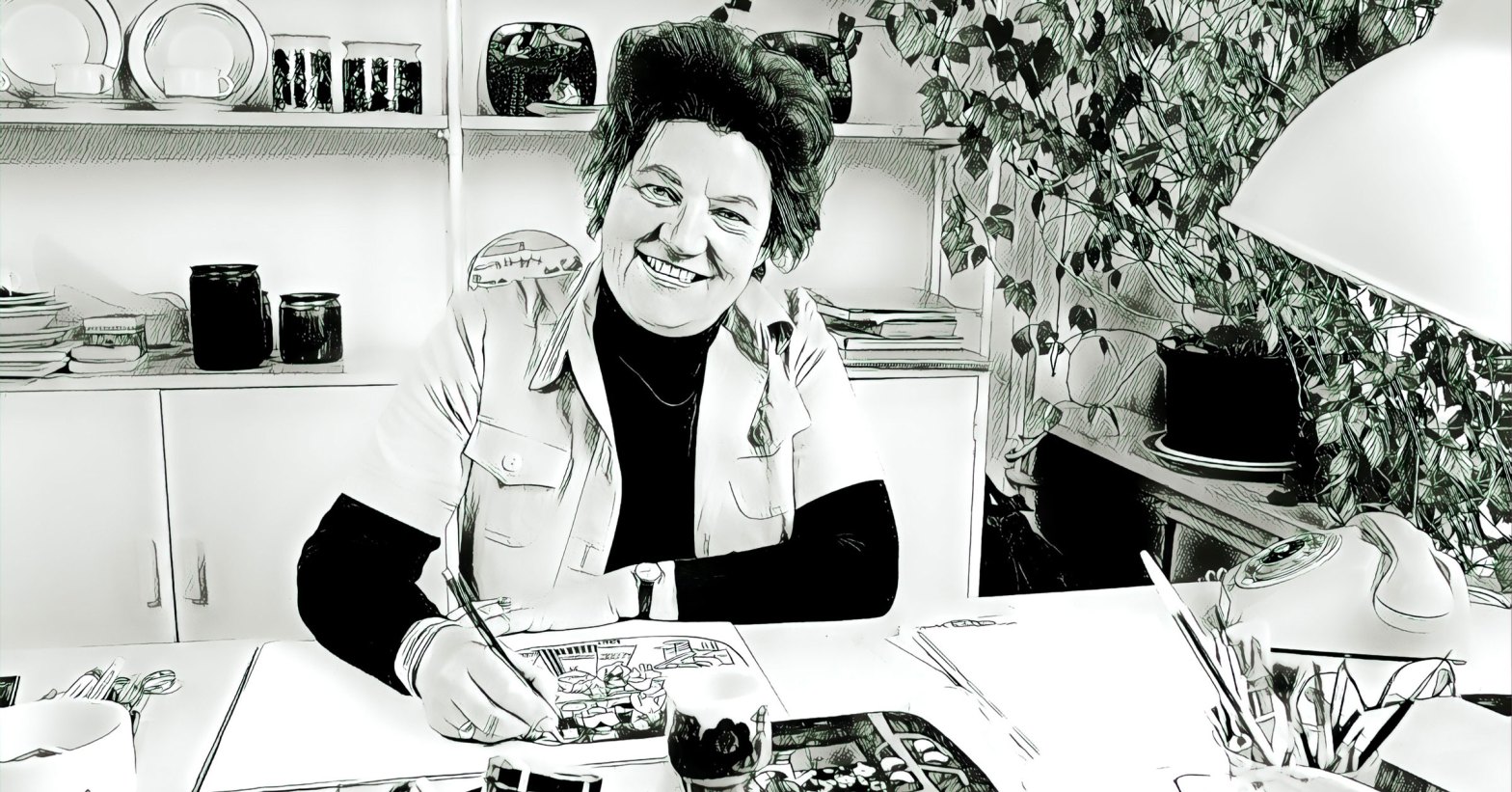
Greta Skogster-Lehtinen (1900 – 1994) ran her own weaving studio for more than fifty years, made her name with the upholstery fabrics and carpets of the Finnish Parliament building, and later, with her husband, set up one of Finland’s private arts foundations.
She was born Greta Skogster in Hämeenlinna and went to the Swedish-language co-educational school there. Encouraged by the architect Armas Lindgren, she started at the Central School of Arts and Crafts in Helsinki at fifteen, studying design drawing, and learned weaving at the Wetterhoff crafts college back home. In 1921 she founded her own weaving, dyeing and textile design business, first in Hämeenlinna and later in Helsinki, and alongside it was artistic director of Kotiahkeruus Oy in Helsinki.
Her breakthrough was the Parliament House, completed in 1931, for which she designed the furniture fabrics and large carpets. Large commissions for public buildings, churches and company headquarters followed, and at Alvar Aalto’s personal request she furnished large passenger ships. One of her most important works is the tapestry for the council chamber of Kotka town hall. She helped modernise the ryijy and tapestry, and during the wartime shortages she designed wallpapers of birch bark and straw. Her work was recognised at the Milan Triennale in 1933 and at the world’s fairs in Brussels in 1935, Paris in 1937 and New York in 1939.


In 1935 she married the industrialist William Lehtinen and moved the business to Enso, then back to Helsinki when the Winter War broke out. She retired in 1974. The couple set up a named fund at the Finnish Cultural Foundation in 1964, and the Greta and William Lehtinen Foundation, which gives grants to artists, in 1968. For a time the foundation owned Castello di Pratelli near Florence. A plan to turn their property on Kuusisaari in Helsinki into an art museum fell through over zoning, but in 2020 the foundation opened an artists’ residence in Helsinki.
- Greta Skogster-Lehtinen, born Skogster
- 1900 – 1994
- Studied at the Central School of Arts and Crafts, Helsinki, and Wetterhoff, Hämeenlinna
- Own weaving and textile design business 1921 – 1974
- Textiles for the Finnish Parliament House, 1930 – 1931
Sources:


Leave a Reply