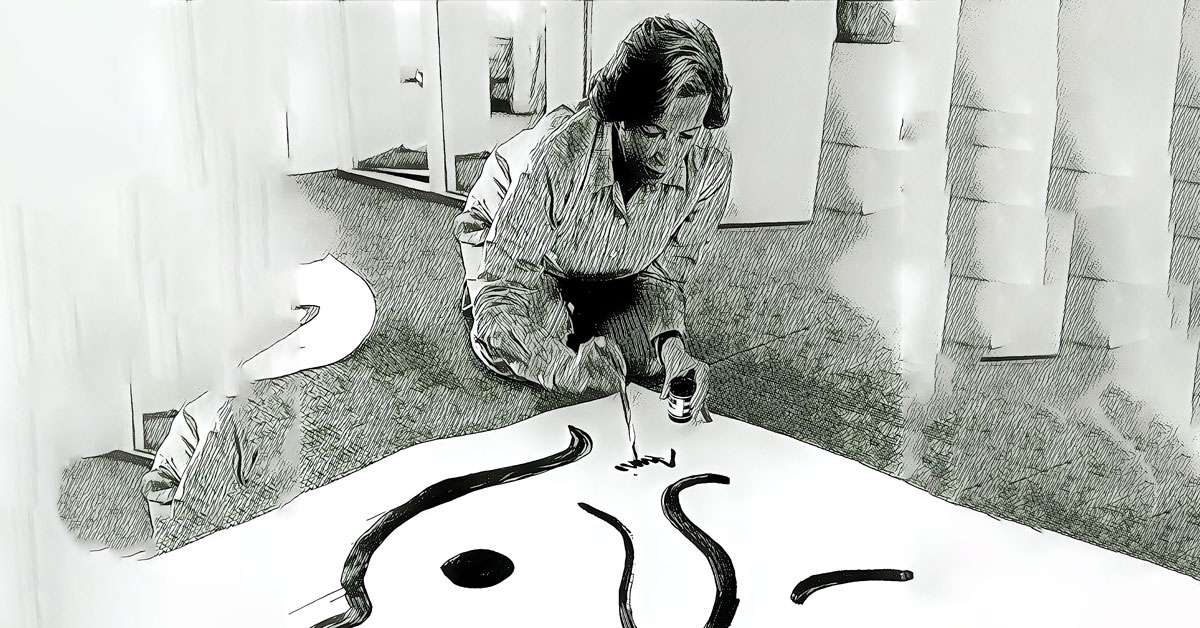
Armi Ratia (1912 – 1979) trained as a textile designer, but her real talent was for spotting other designers and building a story around them. The company she started in 1951 to sell her husband’s printed cotton became Marimekko.
She was born Armi Maria Airaksinen in Pälkjärvi in Ladoga Karelia, the daughter of a merchant and a schoolteacher. She studied textile design at the Central School of Arts and Crafts, and in 1935 married Viljo Ratia, an officer and businessman, and opened her own weaving workshop in Viipuri, which she ran until 1939. During the war she worked as an office clerk at the Ministry of Defence, then as a copywriter at the advertising agency Erva-Latvala. In 1949 she joined Printex, her husband’s company, which had started with oilcloth and moved on to printed fabrics.
In 1951 she and the clothing designer Riitta Immonen founded Marimekko to design and sell clothes made from Printex fabrics. Maija Isola, who had won a printed-fabric competition while still a student, had been working for Printex since 1949. Vuokko Nurmesniemi joined as a designer in 1953, and Helge Mether-Borgström drew the logo in 1954. Every designer’s name was printed on the selvedge of the cloth, so the women behind Marimekko’s patterns never disappeared behind the brand. The international breakthrough came in 1960, when Jacqueline Kennedy wore Marimekko during her husband’s election campaign and appeared in a Marimekko dress on the cover of Sports Illustrated. Ratia had ruled out floral prints, but in 1964 Isola ignored her and drew Unikko, which became the company’s bestseller. In the early 1960s Ratia threw herself into Marikylä, a planned “world village” that was to be a design laboratory and a home for the staff. That and an expensive way of life ate into the profits, and in 1966 Marimekko and Printex were merged and then sharply restructured. At around the same time she received the Neiman Marcus Fashion Award in the United States.
During the lean years Annika Rimala’s Tasaraita striped jersey became a huge success. In the early 1970s Ratia began licensing Marimekko design abroad, and the company was profitable again. It received the President of the Republic’s export award and was listed on the stock exchange in 1974. Ratia was managing director until 1969 and again from 1971 until her death in 1979, and is buried in Hietaniemi cemetery in Helsinki. A park near her old home in Kaivopuisto was named after her in 2015.


- Armi Maria Ratia, born Airaksinen
- 1912 – 1979
- Studied textile design at the Central School of Arts and Crafts, Helsinki
- Co-founded Marimekko with Riitta Immonen in 1951
- Managing director of Marimekko 1951 – 1969 and 1971 – 1979
Sources:
National Biography of Finland: Ratia, Armi (1912 – 1979) (Antti Ainamo)
Yle Elävä arkisto: Armi Ratia ja Marimekon kulta-aika
Finnish Design Shop: Armi Ratia
Anne Massey: Women in Design, Thames & Hudson, London, 2022, pp. 146 – 147
Read next: Maija Isola, whose Unikko became Marimekko’s best-known print, Marjatta Metsovaara, another Finnish woman who ran her own textile company, and Dora Jung, who ran her own weaving studio in Helsinki. All Marimekko designers are here.

Leave a Reply