
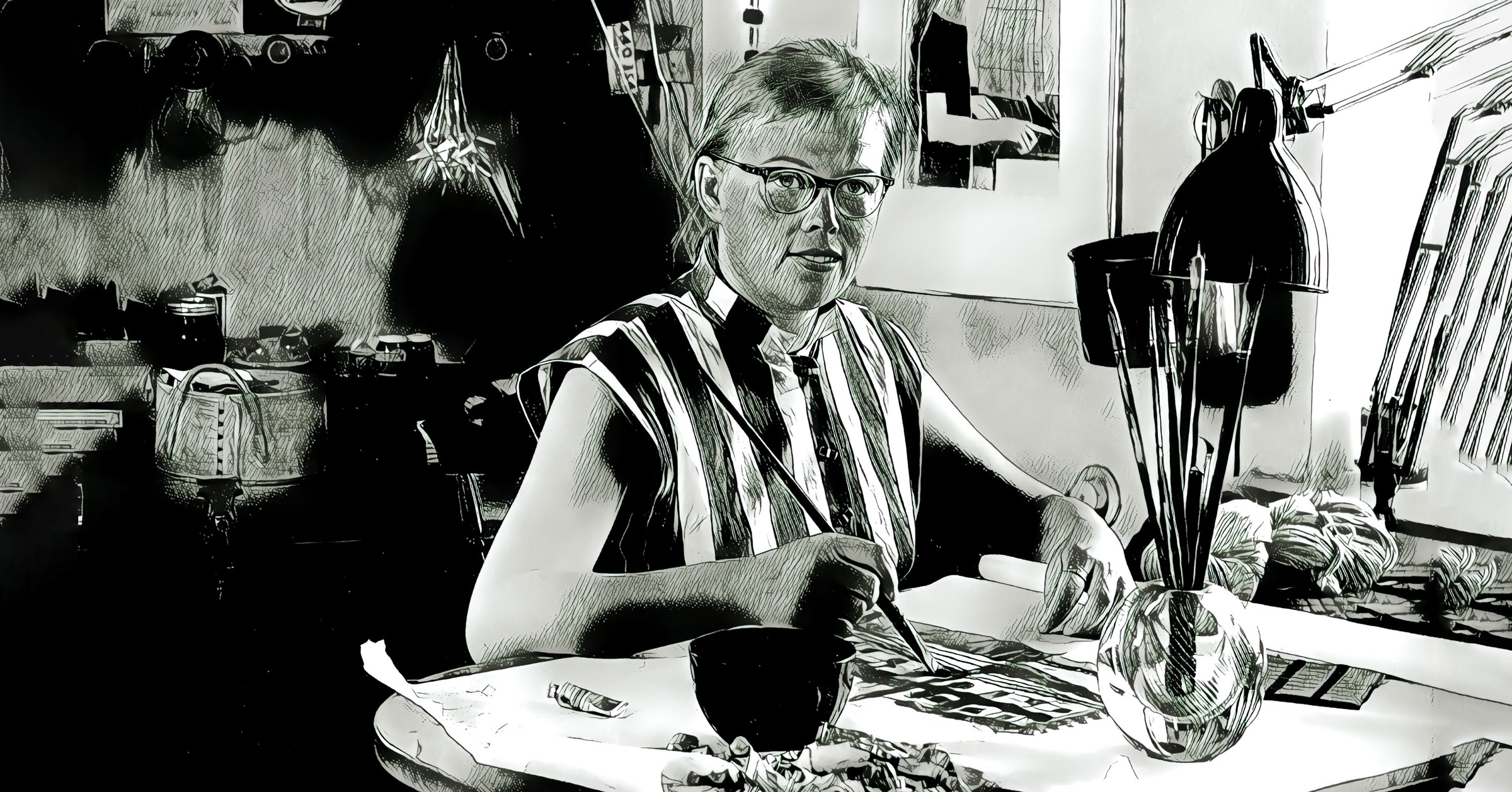
Estrid Ericson (1894 – 1981) put Swedish peasant furniture next to English Windsor chairs, Ming bronzes and strict modernism, and somehow it all came out as one comfortable room. That eye ran Svenskt Tenn, the Stockholm shop she founded in 1924 and led until 1978.
She was born Estrid Maria Erikson in Öregrund and grew up in Hjo on Lake Vättern, where her father ran the town and spa hotel. She trained as a drawing teacher at Tekniska skolan in Stockholm from 1913 to 1918, in the same class as Tyra Lundgren, and taught one term back in Hjo. Then came Svensk Hemslöjd, and from 1920 to 1924 a job as an adviser in the Vackrare vardagsvaror department of the interiors firm Wikman & Wiklund.
Money left by her father paid for the start, and she was 30. Looking back, she called herself unrealistic and impractical at the time, with little but good taste to go on. Svenskt Tenn means Swedish Pewter, and at first that is what it sold: modern pewter, much of it her own design, made by her co-founder Nils Fougstedt and two others. It won a gold medal at the Paris exhibition of 1925. Uno Åhrén, Björn Trägårdh, Tyra Lundgren and Anna Petrus designed for her too, and she had no qualms about adapting their work to her own taste: Petrus’s lions ended up decorating her boxes. In 1927 the shop moved from Smålandsgatan to Strandvägen, where it still is. The same year it showed in New York, and in 1928 it became purveyor to the Swedish court. In 1930 she moved into a flat in the same building, and furnishing it turned her towards interiors: from then on the shop sold furniture, textiles and things for the home as well as pewter.
Her best-known hire came in 1934: the Austrian architect Josef Frank, who had left Vienna because of antisemitism. He drew the furniture and the prints, and she decided how they were shown. Eva von Zweighbergk, writing in Form in 1967, put it this way: Ericson approved everything Frank made, and Frank made what she asked for. Between them they softened Swedish functionalism with comfort, colour, pattern and things picked up on travels. She put a great deal of work into his exhibitions at Nationalmuseum, in 1952 and, after his death, in 1968.
Her own designs were smaller things: mirrors, boxes, interior details and, from the early 1940s, pewter jewellery, some of it gold-plated. She made only one fabric print, Elefant. In the 1930s she found a piece of African cloth with elephants on it at a Paris flea market, based on a model from the Belgian Congo, and turned it into a print. Svenskt Tenn still prints it, on linen and on cushions, trays, bags and wallpaper, and it is one of the patterns the shop is best known for. The shop also still sells the plain Jam Jar vase, which she counted among the four vases every home should have.
She is also credited with bringing functionalist furniture to Sweden. Her early rooms were spare; later she set modernist furniture in contrasting colours against bright interiors. She wanted a room to feel calm, with no colour overdone, as she told an interviewer in 1932, but she had no time for colour schemes worked out in advance. A home, she thought, got its character from the things people collected over a life. In 1939 she published The Catechism of Interior Design, which says simply: “Our homes are never completed.”
In 1975, at 81, she sold the company to the Kjell and Märta Beijer Foundation and stayed on as artistic director until Ann Wall took over in 1978. In her last years she went back to designing pewter. She had a summer house, Tolvekarna in Tyresö, from 1931, married the sea captain Sigfrid Ericson in 1944, and is buried in Hjo.


- Estrid Maria Ericson, born Erikson
- 1894 – 1981
- Trained as a drawing teacher at Tekniska skolan, Stockholm, 1913 – 1918
- Founded Svenskt Tenn in 1924 and ran it until 1978
- Gold medal for pewter, Paris 1925; purveyor to the Swedish court from 1928
- Designed the Elefant print, 1930s
- Worked with Josef Frank from 1934
Sources:
Svenskt kvinnobiografiskt lexikon: Estrid Ericson
Svenskt Tenn: The story behind the Elefant pattern
Read next: Elsa Gullberg, who ran Stockholm’s other great modern interiors firm, Märta Måås-Fjetterström, who showed with Svenskt Tenn at Liljevalchs in 1934, and Nathalie Krebs, who exhibited her Danish stoneware at the shop in 1930. All Swedish designers are here.



Leave a Reply