
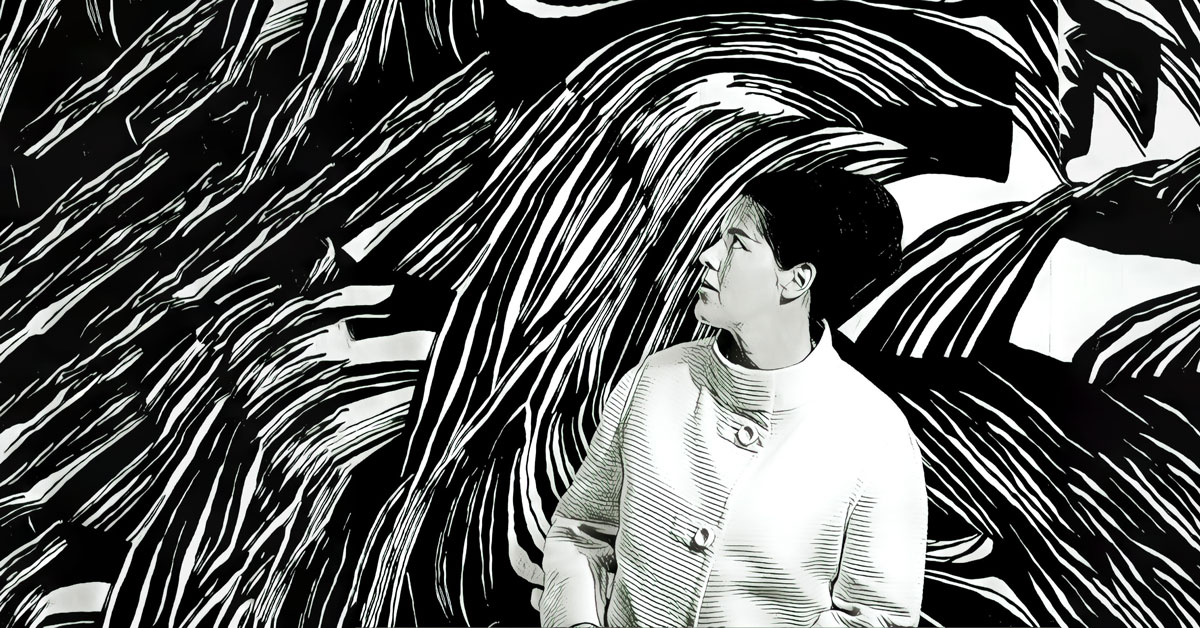
Ice Stream, also translated as Ice Flow, is Rut Bryk’s last major work: a seven-panel wall relief of small glazed tiles, made between 1987 and 1991 for Mäntyniemi, the residence of the Finnish president. Butterflies run through her earlier work, a personal motif, since her father was a lepidopterist, and a touring exhibition of about 200 of her pieces went to Japan in 2019 – 2020 under the title Touch of a Butterfly.
She was born Linnea Rut Bryk in Stockholm in 1916, the daughter of the writer, painter and entomologist Felix Bryk and Aino Mäkinen. She studied graphic art at the Central School of Industrial Arts in Helsinki from 1936 to 1939, began as an illustrator and textile designer, and in 1942 joined the art department at Arabia, where Birger Kaipiainen was among those she learned from.
At first she decorated other artists’ ceramics, then made colourful dishes, trays, jewellery and plaques, figurative, often naively poetic and intensely coloured, full of dreams and childhood memories. From 1948 to 1950 she worked out a slip-casting method close to printmaking, carving plaster moulds so that each plaque came out unique even though the mould was reused. Her tile designs won first prize at the Milan Triennale in 1951. In the late 1950s she began building larger reliefs from modular tiles; The City was shown at the Brussels World’s Fair in 1958, and her first monumental piece, The Banquet Table (1961), hangs at the Rosenthal porcelain factory in Germany. In the late 1960s she set white tiles against bright, Pop-like colour, and from the 1970s worked with light and shadow, simpler geometric forms and fewer colours, rearranging the tiles many times before a composition was fixed. City in the Sun (1975) is in the stairwell of Helsinki City Hall.


She also designed the Seita textiles for Vaasan Puuvilla and Finlayson in the 1960s, sold by the metre and made into tablecloths, bed linen and towels, and decoration for her husband Tapio Wirkkala’s Winterreise Polygon and Cumulus Century services for Rosenthal. She received the Pro Finlandia medal in 1962, the State Prize for Applied Art in 1974 and an honorary doctorate from the University of Helsinki in 1994. She died in 1999. She and Wirkkala had two children, the interior architect Sami Wirkkala and the artist Maaria Wirkkala, and are buried together at Hietaniemi cemetery. Their legacy is looked after by the Tapio Wirkkala Rut Bryk Foundation, whose collection has been at EMMA, the Espoo Museum of Modern Art, since 2011.
- Linnea Rut Bryk
- 1916 – 1999
- Central School of Industrial Arts, Helsinki, 1936 – 1939
- Arabia art department from 1942
- First prize, Milan Triennale, 1951; Pro Finlandia 1962; State Prize for Applied Art 1974
- Ice Stream (1987 – 1991), Mäntyniemi; City in the Sun (1975), Helsinki City Hall
Sources:
Kansallisbiografia: Bryk, Rut (1916 – 1999), Finnish Literature Society
EMMA: Rut Bryk exhibition opened in Tokyo
Read next: Esteri Tomula, who joined Arabia a few years after her and, like her, began by decorating other designers’ pieces, and Raija Uosikkinen, whose printed patterns were on Arabia tableware for three decades. All Arabia designers are here.


Leave a Reply