
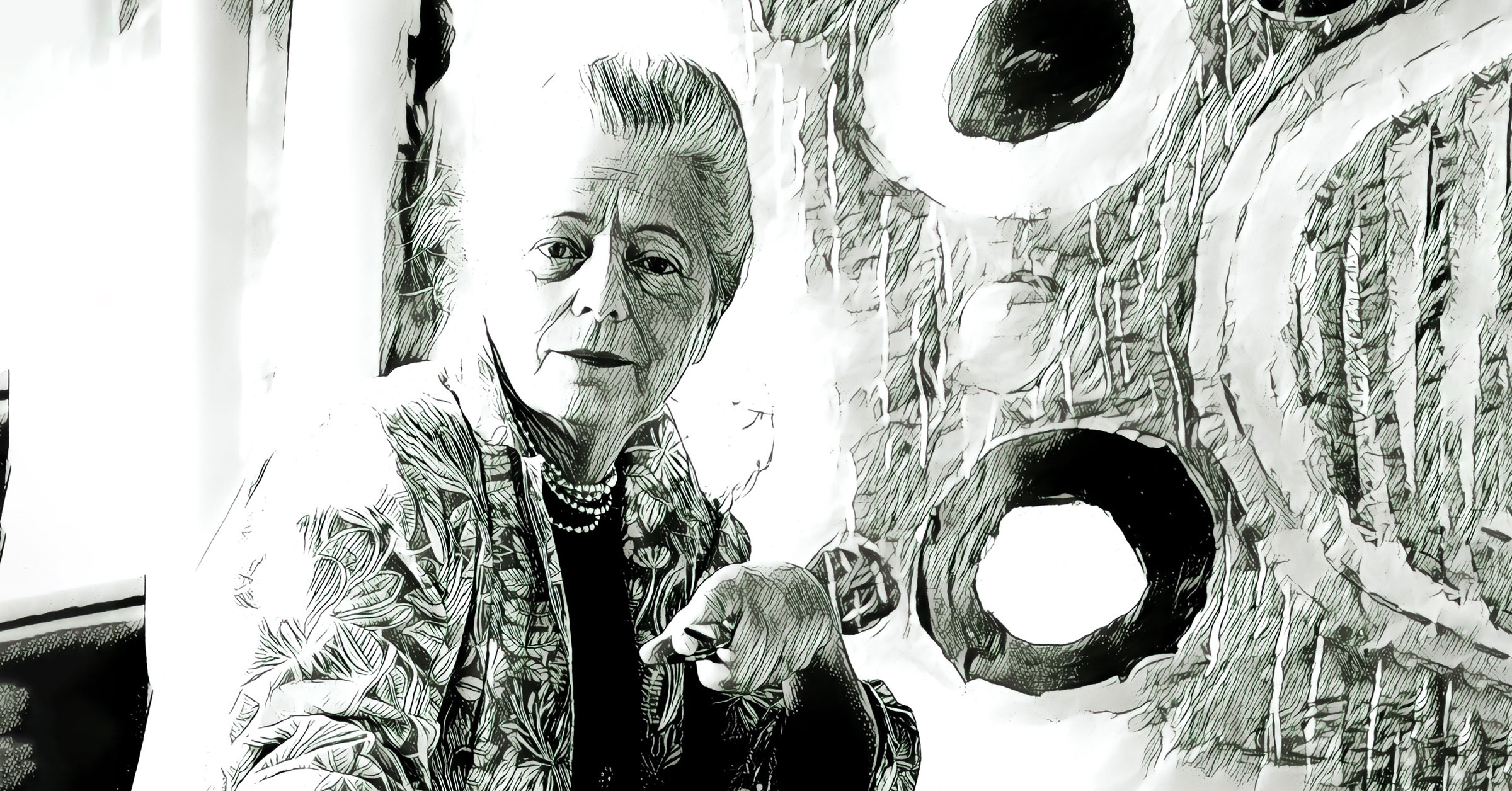
Lena Larsson (1919 – 2000) ran NK-bo, the Stockholm department store’s shop for young families, and then spent the rest of her working life telling Swedes how to live in their homes: in newspaper columns, in books and, in 1960, in an article that left the language a phrase, “köp, slit och släng”.
She was born Lena Rabenius in Tranås, where her father was being treated for tuberculosis at Romanäs sanatorium, and grew up in Stockholm. He died when she was five. At ten she went with her grandfather to the Stockholm Exhibition of 1930, the fair that brought functionalism to Sweden. She trained at Carl Malmsten’s workshop school, and in 1940 she married the architect Mårten Larsson. They had four children. From 1942 to 1944 she worked for the architect Elias Svedberg, and from 1944 to 1947 for the housing committee of the Swedish Society of Crafts and Design. During the war she went on home visits for its survey of how people actually used their homes: where they ate, where they slept, whether there was room for the children. She later called it the job of her life.
In 1947 she and Svedberg started NK-bo, a shop with showrooms inside Nordiska Kompaniet, aimed at younger and less well-off customers than the store usually served. As artistic director and chief designer until 1956 she sold the flat-pack Triva furniture, gave room to young designers such as Stig Lindberg, Yngve Ekström and Kerstin Hörlin-Holmquist, and ran courses in interior design. With Svedberg she wrote the book Heminredning. She wanted homes that were practical and beautiful, where children could play and romp, and she is credited with the idea of the allrum, the shared everyday room. At H55 in Helsingborg she furnished Skal och kärna (Shell and Core), a house by Mårten Larsson and Anders William-Olsson built around exactly such an open, child-friendly room. It became one of the most discussed exhibits of the fair.
Then writing took over. She wrote for Expressen from 1950 to 1956. In 1955 the publisher Lukas Bonnier picked her as home editor of Allt i hemmet: the target was 30,000 copies, and after a year the magazine sold close to 100,000. She taught at Konstfack from 1948 to 1980, had made radio since 1946, including a jazz programme of her own, and wrote the books Bo i dag and Barnens vrå. In 1960, in the journal Forum, she answered the consumer journalist Willy Maria Lundberg, who had just defended durable goods in her book Ting och tycken. Larsson’s reply, “Köp, slit och släng” (buy, wear out, throw away), argued that comfort, variety and pleasure counted as much as quality built to last: buy simpler things you love and use them until they are worn out. It led to a television debate in 1961, earned her the nickname “slänghäxa”, the throwaway witch, and brought hate mail for years. In 1972 she pointed out that people had heard the buying and the throwing away and missed the wearing out.
In 1968 she came to the weekly Vi, first standing in on the debate page and then as a freelance, and stayed for more than 25 years, writing about homes, design and music in series such as Vi bor i Sverige and Svenska rum. She also designed furniture of her own, among them rocking chairs for Nesto in the 1960s. Her memoir, Varje människa är ett skåp (Every person is a cupboard), came out in 1991. She died on Lidingö in 2000.


- Lena Christina Larsson, née Rabenius
- 1919 – 2000
- Trained at Carl Malmsten’s Verkstadsskola, Stockholm
- Artistic director and chief designer of NK-bo 1947 – 1956
- Interior of the Skal och kärna house, H55, Helsingborg, 1955
- Taught at Konstfack 1948 – 1980
Sources:
Svenskt kvinnobiografiskt lexikon: Lena Christina Larsson (Sara Kristoffersson)
Tidningen Vi: Lena Larsson ritade det moderna hemmet (Tomas Dur Fläckman, 2019)
IKEA Museum: Life at home in the 1960s
Möbeldesignmuseum: The history behind NK’s Verkstäder (Lars Bülow)
Read next: Estrid Ericson, who furnished Stockholm homes from Svenskt Tenn a generation earlier, Greta Magnusson-Grossman, another Swedish woman who designed furniture and wrote about it, and Grete Jalk, who edited Mobilia in Copenhagen while Larsson wrote for Swedish readers. All interior designers are here.



Leave a Reply