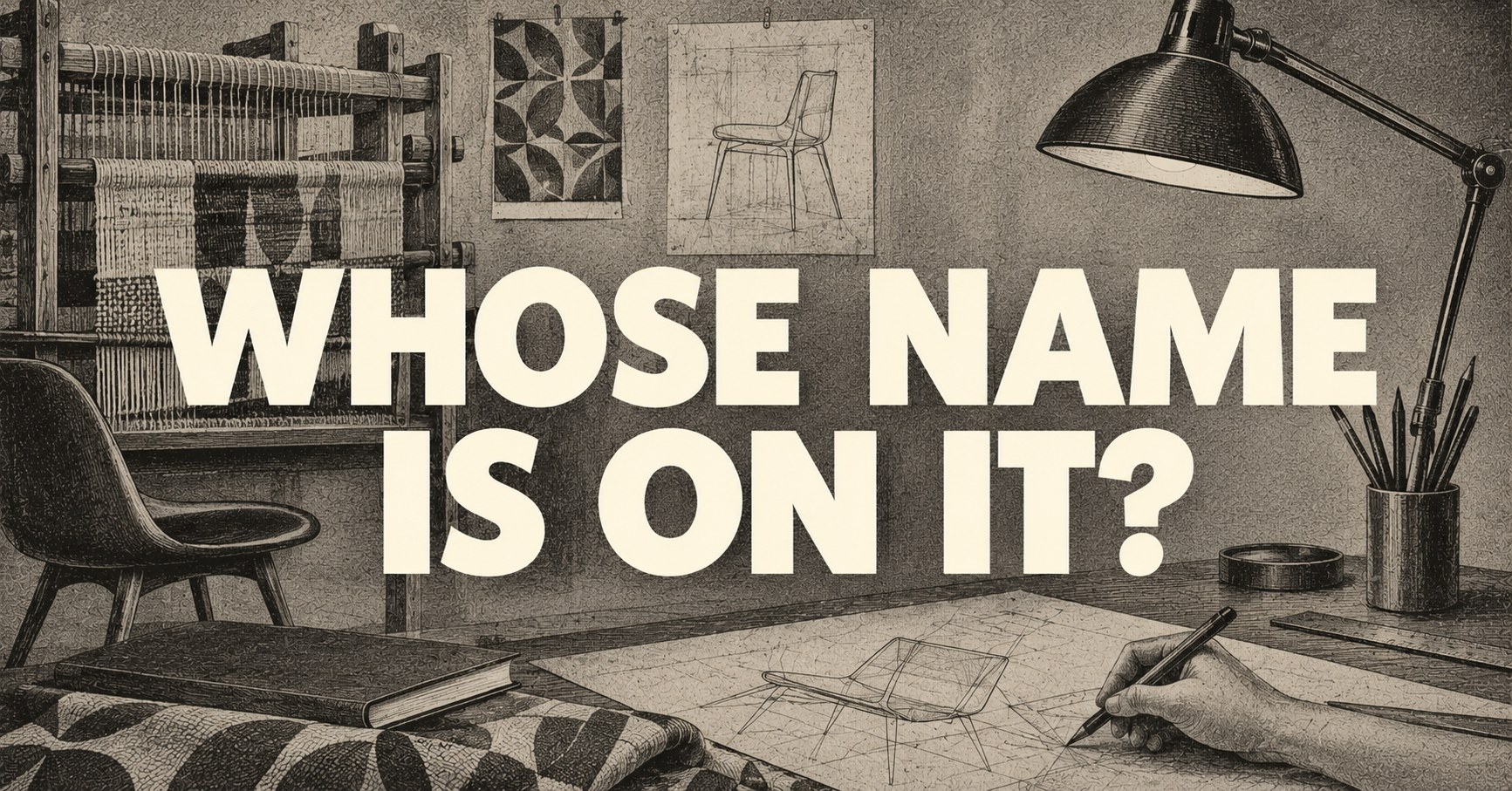
Artek’s archive holds about 5,000 working drawings from the years when Maija Heikinheimo ran its drawing office. Her name is on 977 of them as the person who drew them. As the designer, the person whose idea it was, she appears on 30. At Artek the custom was to credit Alvar Aalto, and Heikinheimo signed only the pieces she thought were less important.
That gap between doing the work and getting the name is the subject of Isabelle Anscombe’s A Woman’s Touch, published in London in 1984 and one of the first books to follow women designers from the 1860s onwards. Anscombe writes almost entirely about Britain, America and Central Europe, and Scandinavia gets only a few pages. But the pattern she describes is easy to recognise from here, and so are the places where the Nordic story runs differently.
The international picture
Anscombe starts with the Victorians, who sorted the arts by sex. Decorative work, careful and refined, was thought to suit women; the fine arts, which called for ambition, were for men. Women did get a foothold through the Arts and Crafts movement, but usually working under a father, a brother or a husband, whose artistic personality swallowed theirs. Many of those who struck out on their own only managed it in their forties, once family life let them go.

Modernism promised something else. At the Bauhaus the classes were mixed, and the ideal designer was anonymous, neither male nor female. Yet when the women students were free to choose a workshop, most of them chose weaving, and the weaving workshop was run by women.
In 1926 Helene Nonné-Schmidt, a weaver at the school, explained why in an article on woman’s place at the Bauhaus: women, she argued, lacked men’s spatial imagination and saw details rather than the whole, which made the flat surface of cloth their natural field. Anscombe’s point is not that the women were wrong to weave. Their workshop did more than most to bring hand weaving into industrial production. Her point is that the old division survived under a new theory.
After the Second World War the division hardened. Women were encouraged back into the home and cast as homemakers and consumers, and women designers, in Anscombe’s account, increasingly ended up designing for other women and for children. When Britain’s Design Centre gave its first awards in the 1950s, a quarter of them went to women: for a wallpaper, for tableware and for a carpet. The television set, the convector heater and the ovenproof glass were designed by men. Anscombe reads it as the moment the line between decorative and functional design was drawn by sex. Her conclusion, in 1984, is that women succeed in textiles, interiors and crafts not because their talents lie there by nature but because that is where their work has a market value, while the design office itself is run by men.
The Nordic picture
Much of that fits the Nordic countries too. Textiles were where women were strongest. Anscombe notes that many Scandinavian craft associations were founded by women in the nineteenth century and did their best work in rugs and textiles, and the names on this site bear her out, from Märta Måås-Fjetterström‘s rugs in Båstad onwards. When Anscombe wants a Scandinavian example, she picks Astrid Sampe, head of the textile studio at the Stockholm department store NK from 1937, whose neutral, textured weaves influenced British designers and who sat on the Design Centre’s first selection committee in 1957. A Swedish woman judging British design was no small thing. She was there, though, as a textile designer.
The credit problem is here as well. Aino Aalto worked as Alvar Aalto’s equal from 1924, but entries went in under both names or the office’s, and their grandson Heikki Aalto-Alanen has shown how often her name was left off, or taken off, work they did together. Trade catalogues show the same habit in small print. A Danish catalogue from France & Søn credits a sofa series as drawn by “frøken Grete Jalk“, Miss Jalk, while the men carry the letters of the architects’ association or the title of professor. A Fritz Hansen price list from 1964, printed for Norway, names Jacobsen, Panton, Klint and others, and not a single woman.
Some things were different, though, and they are worth saying plainly. In Finland women could not only vote starting 1906 but could also train as architects early: Signe Hornborg qualified in 1890, and by 1930 nearly a third of the members of the Finnish Association of Architects were women, which was unusual anywhere. Interior architecture was open to both sexes. In some countries furniture was treated as men’s work and interiors as women’s, but a Finnish interior architect could specialise in either. The Turku furniture maker Boman took on young women interior architects as permanent staff in the late 1930s. And the big factories hired women as artists: at Arabia, Rörstrand and Gustavsberg women worked in the art departments under their own names, and some of the best-known Nordic tableware of the 1950s carries a woman’s name.
Even in Finland the women had to make their own room first. In 1919 the women studying architecture at the Polytechnic set up a club of their own, Tuumastukki, because the associations run by men left them none. It had no premises; the members met in each other’s homes, held talks, excursions and parties, and set each other mock competitions. In the 1940s the club grew into Architecta, the association of Finnish women architects.
What the archive is for
Anscombe ends on a hard note: women are judged by a system that limits them and then holds the limits against them. Forty years on, the Nordic material allows a slightly better ending. The work is there. It survives in factory archives, in exhibition catalogues and yearbooks, in drawing registers like Artek’s, where a woman’s hand is on almost a thousand sheets. What went missing was the name. Putting it back, one designer at a time, is what this site is for.
Sources:
Isabelle Anscombe: A Woman’s Touch. Women in Design from 1860 to the Present Day, Virago, London, 1984, introduction and pp. 134 – 135, 153, 187 – 190, 196 – 197
Renja Suominen-Kokkonen: The Fringe of a Profession. Women as Architects in Finland from the 1890s to the 1950s, Suomen Muinaismuistoyhdistys, 1992
Ulla Kinnunen (ed.): Aino Aalto, Alvar Aalto Museum, Jyväskylä, 2004
France & Søn, Hillerød, furniture catalogue; Fritz Hansen, net price list for Norway, 1964 (collection of the author)
Read next: Maija Heikinheimo, whose 977 drawings open this essay, Aino Aalto, whose name was so often left off, and Grete Jalk, the “frøken” in the France & Søn catalogue. All essays are here.


Leave a Reply